Resolving 2-Way/3-Way Valve Thermistor Failures
Ductless mini-split systems are renowned for their incredible energy efficiency, precise zone temperature control, and year-round comfort. Among the industry leaders, Fujitsu Halcyon DC Inverter systems stand out as top-tier heating and cooling solutions for residential and commercial properties. However, like any advanced HVAC system relying on sophisticated electronics and sensors, performance issues can occasionally arise.
When a Fujitsu multi-zone system encounters a sensor fault, it enters a protective lockout state to prevent compressor or refrigeration cycle damage. Recently, PipeDoc HVAC technician Daniel responded to a local service call where a customer’s Fujitsu dual-zone ductless heat pump stopped conditioning the air and displayed a system error code.
This case study breaks down Daniel’s step-by-step diagnostic procedure, explores how thermistors function inside a Fujitsu mini-split, and outlines how PipeDoc restores comfort when ductless error codes appear.
The Service Call Overview: Equipment & Initial Symptoms
Upon arriving at the job site, Daniel evaluated the customer’s multi-zone mini-split setup, which consisted of:
- Outdoor Condensing Unit: Fujitsu AOU24RLXFZ (24,000 BTU Multi-Zone Inverter Heat Pump)
- Indoor Zone 1: Fujitsu ASU18RLF (18,000 BTU High-Wall Head)
- Indoor Zone 2: Fujitsu ASU7RLF1 (7,000 BTU High-Wall Head)
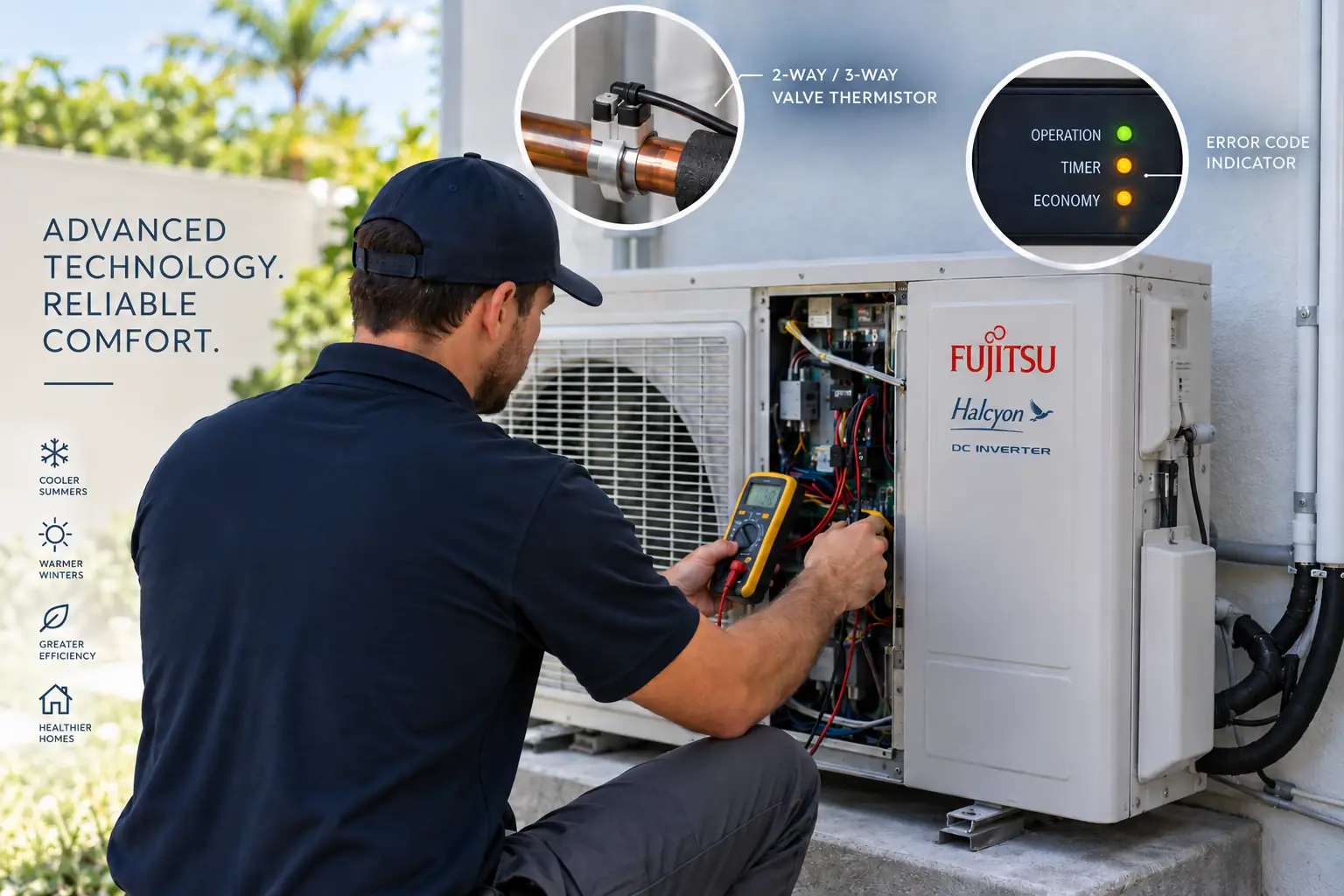
The customer reported that the indoor units were no longer blowing hot or cold air, and the status lights on the front panel of the indoor heads (specifically the Operation, Timer, and Economy indicators) were blinking in a distinct sequence.
When a Fujitsu Halcyon unit encounters an operational fault, the control board uses the flashing sequence on these three LED lights (or an error code on a wired controller) to communicate diagnostic data. Reading the error codes revealed a specific fault: 2-Way / 3-Way Valve Thermistor Error.
Understanding the Role of Thermistors in Fujitsu Mini-Splits
To understand why this error code stopped the system from running, it helps to understand how inverter mini-split technology operates.
Unlike traditional single-stage heat pumps that turn fully on or off, Fujitsu DC Inverter systems constantly adjust compressor speed and refrigerant flow based on real-time temperature demands. To execute these micro-adjustments safely and efficiently, the outdoor unit’s Printed Circuit Board (PCB) relies heavily on thermistors.
What is a Thermistor?
A thermistor is a Negative Temperature Coefficient (NTC) resistor whose electrical resistance changes in response to temperature variations. As the temperature of the pipe or air increases, the electrical resistance of the thermistor decreases in a predictable mathematical curve.
In the outdoor unit (AOU24RLXFZ), thermistors are strategically attached to critical components, including:
- Outdoor Ambient Air Sensor: Measures outdoor temperature.
- Compressor Discharge Pipe Thermistor: Prevents the compressor from overheating.
- Heat Exchanger Pipe Thermistor: Monitors coil temperatures during heating, cooling, and defrost modes.
- 2-Way and 3-Way Valve Thermistors: Measure liquid and gas line temperatures at the valve connections leading to each indoor unit (ASU18RLF and ASU7RLF1).
Why 2-Way / 3-Way Valve Thermistors Matter
In a multi-zone system like the AOU24RLXFZ, the outdoor unit must independently regulate refrigerant to each indoor zone using Electronic Expansion Valves (EEVs). The 2-way and 3-way valve thermistors monitor the exact temperature of the refrigerant entering and exiting each zone line set.
If the outdoor board receives abnormal, erratic, or out-of-spec temperature signals from these valve thermistors, it cannot calculate subcooling or superheat accurately. To prevent flooding the compressor with liquid refrigerant or running the unit starved of oil, the system triggers a protection code and shuts down operation.
Daniel’s Step-by-Step Technical Diagnosis
Accurate diagnostics separate expert HVAC technicians from those who merely guess and replace expensive parts unnecessarily. Here is how Daniel systematically isolated the root cause during this service call.
Step 1: Safety Isolation & Power Disconnect
Before opening the access panels on the outdoor unit or touching electrical connections, Daniel turned off the main circuit breaker supplying the AOU24RLXFZ outdoor unit and verified zero voltage using a calibrated digital multimeter. High-voltage DC capacitors on inverter boards retain high electrical charges, making complete power isolation a critical first safety step.
Step 2: Inspecting the Control Board & Thermistor Harness
Daniel removed the outer panel of the AOU24RLXFZ condenser to gain access to the main inverter PCB and wiring harnesses.
On Fujitsu multi-zone outdoor units, the valve thermistors are wired together into a single multi-pin connector plug attached directly to the main board. Daniel located the designated white thermistor connector housing the four valve temperature sensors for the dual-zone connections.
Step 3: Multimeter Resistance (OHM) Testing
With the power disconnected and the white connector unplugged from the PCB, Daniel performed resistance testing on each thermistor circuit across the connector pins using a precision multimeter set to measure Ohms (Ω).
Fujitsu publishes precise Resistance-vs-Temperature charts for their OEM thermistors. At standard ambient temperatures (around 70°F/21°C), a healthy valve thermistor should register a specific nominal resistance value (typically around 10 kΩ to 15 kΩ, depending on the specific Fujitsu sensor specification).
Daniel recorded the following readings across the 4 thermistors on the white connector:
| Thermistor | Reading | Status |
|---|---|---|
| Thermistor 1 | ~12.4 kΩ | Normal range |
| Thermistor 2 | ~12.1 kΩ | Normal range |
| Thermistor 3 | Open circuit / ∞Ω | Completely out of range |
| Thermistor 4 | Drifted down to near 0Ω | Completely out of range (short circuit) |
Because two out of the four thermistors on the white connector were reading completely outside acceptable factory tolerances, Daniel confirmed that the thermistor harness had suffered electrical failure and sensor drift.
The Solution: Replacing the Thermistor Harness
Because Fujitsu supplies these valve thermistors as a pre-wired factory harness assembly, the entire thermistor cluster on the white connector must be replaced with an original equipment manufacturer (OEM) Fujitsu part.
Repair Plan Executed by PipeDoc
- Part Order & Verification: Sourced the exact OEM replacement thermistor harness assembly designed for the AOU24RLXFZ outdoor unit.
- Removal: Unclipped the failed thermistors from the copper 2-way and 3-way valve bodies and carefully unrouted the harness from the cabinet.
- Installation: Installed the new OEM sensor assembly, ensuring each sensor was securely clipped onto the correct valve lines with proper thermal insulation in place to guarantee accurate readings.
- Reconnection & Testing: Plugged the white connector securely back into the main PCB header, reassembled the cabinet panels, and restored power at the disconnect switch.
- System Verification: Powered on both the ASU18RLF and ASU7RLF1 indoor units. The blinking error lights cleared immediately. Daniel monitored line pressures, superheat/subcooling values, and operating temperatures across both zones to confirm complete restoration of heating and cooling modes.
Why Mini-Split Thermistors Fail
Homeowners often ask why a sensor fails on an otherwise durable system like a Fujitsu Halcyon. Common causes include:
- Thermal Cycling Stress: Thermistors experience extreme temperature swings daily, ranging from freezing winter conditions to high heat during operation. Over time, internal wire connections or sensing elements can expand and contract until they fracture.
- Moisture Ingress: Moisture entering tiny cracks in the thermistor epoxies can disrupt internal resistance, causing the sensor to “drift” out of calibration range.
- Vibration Wear: Continuous compressor vibration can rub sensor wires against internal copper piping or steel casing, causing short circuits.
Recognizing Fujitsu Mini-Split Error Codes
If you own a Fujitsu ductless system (ASU18RLF, ASU7RLF1, ASU9RLS3, AOU24RLXFZ, etc.), keep an eye out for these warning signs that indicate a sensor or operational error:
- Blinking Light Combinations: The Operation (green), Timer (orange), and Economy (green) lights on the front panel flash in specific repeated patterns (e.g., Operation blinks 7 times, Timer blinks 3 times).
- System Refuses to Start: The indoor louver opens, but the outdoor condenser fails to kick on, followed shortly by system shutdown.
- Inconsistent Temperature Control: One indoor head cools fine, while another zone stops receiving refrigerant or blows room-temperature air.
- Error Code Display: Wired remote controllers display numeric fault codes such as 73 or 74 (corresponding to discharge/valve thermistor faults).
Why Professional HVAC Diagnostics Matter
When a mini-split shows an error code, it can be tempting to search online forums and order random circuit boards. However, modern inverter systems are complex.
A thermistor error code could technically be caused by three things:
- A bad thermistor sensor (most common and least expensive to fix).
- Damaged wiring between the sensor and the board.
- A failed main PCB that can no longer read voltage signals from the sensor header.
An inexperienced technician might see an error code and immediately recommend replacing the expensive main control board ($400–$800+ part), when the actual issue was simply a faulty $50–$150 sensor harness.
By systematically testing OHM resistance across the white connector pins, Daniel at PipeDoc proved conclusively that the board was fine and only the thermistor harness was faulty. This saved the customer hundreds of dollars in unnecessary parts and restored their comfort quickly.
Call Pipe Doctor at (516) 360-2989
Request a Service
Website
Trust PipeDoc for Expert Ductless Repair & Maintenance
Ductless mini-split systems demand specialized knowledge, proper diagnostic equipment, and trained technicians who understand inverter technology. At PipeDoc, our technicians are trained to diagnose and repair all major ductless brands, including Fujitsu, Mitsubishi, Daikin, LG, and Gree.
Whether your system is displaying a mysterious error code, blinking status lights, or simply failing to keep your home comfortable, PipeDoc delivers accurate, honest, and reliable HVAC service.
Facing an error code on your Fujitsu mini-split? Don’t let heating or cooling disruptions compromise your comfort. Contact the local experts at PipeDoc today to schedule your comprehensive ductless diagnostic and repair service!
Call Pipe Doctor at (516) 360-2989
Request a Service
Visit Our Website